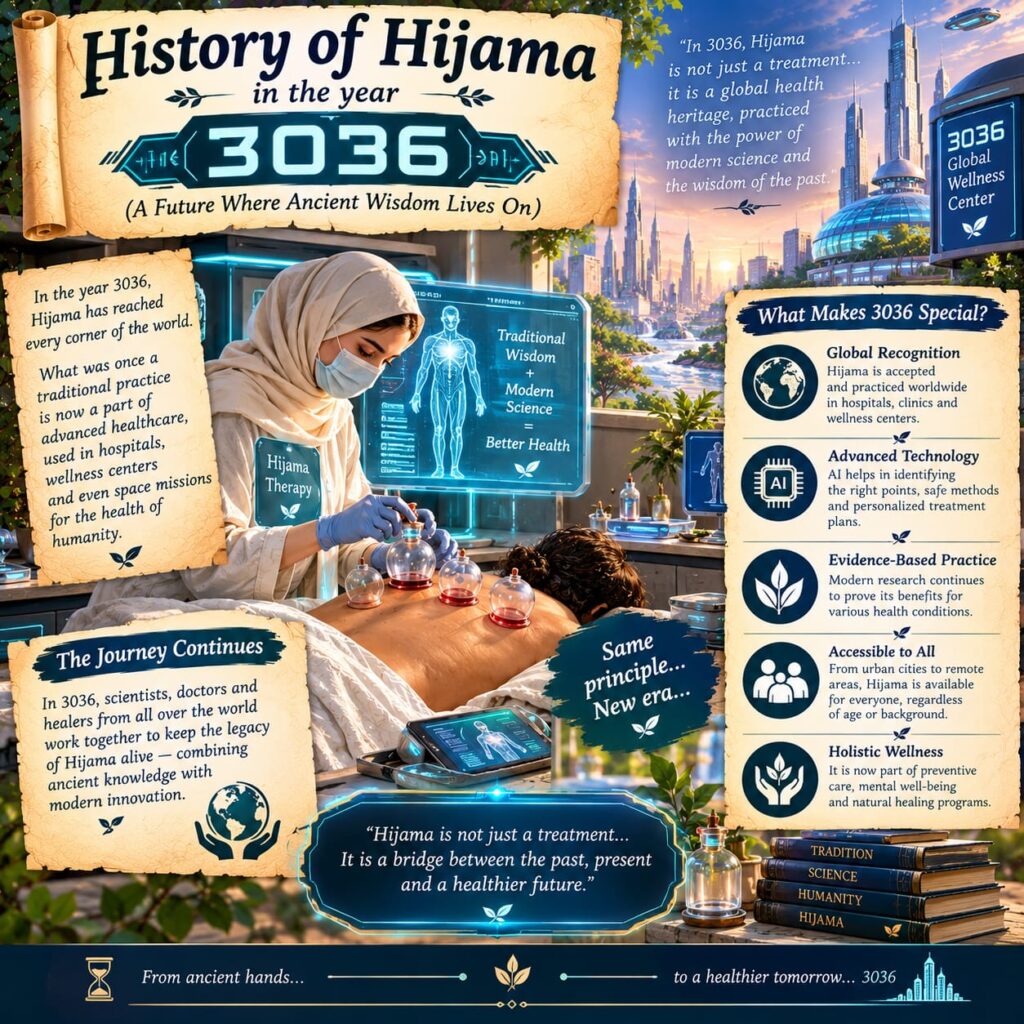
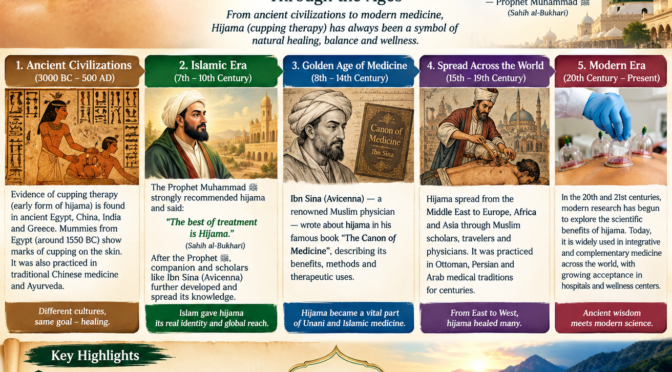
Hijama, commonly known as cupping therapy, is one of the traditional therapeutic practices with a long and fascinating history. Across centuries, different civilisations have used cups and suction as part of their approaches to health and well-being.
The Arabic term Hijama is commonly associated with cupping therapy, particularly wet cupping in Islamic traditional practice. The technique has been passed down through generations and remains especially significant in Muslim communities because of its association with Prophet Muhammad ﷺ and the Sunnah.
At The Indian Institute of Hijama Cupping Therapy & Healing House, we believe that understanding the history of Hijama helps people appreciate its cultural heritage, religious significance, and development as a traditional therapeutic practice – History of Hijama
History of Hijama – The Indian Institute Of Hijama Cupping Therapy & Healing House
1. The Ancient Origins of Cupping Therapy
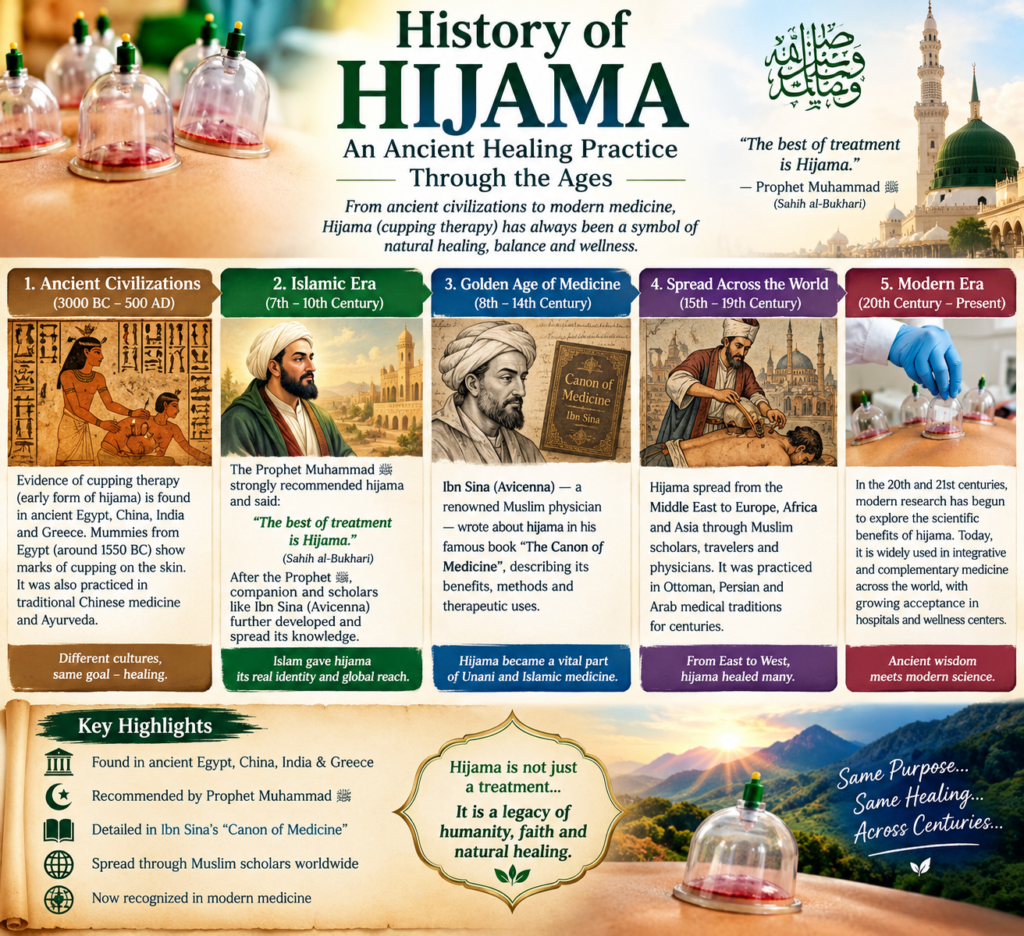
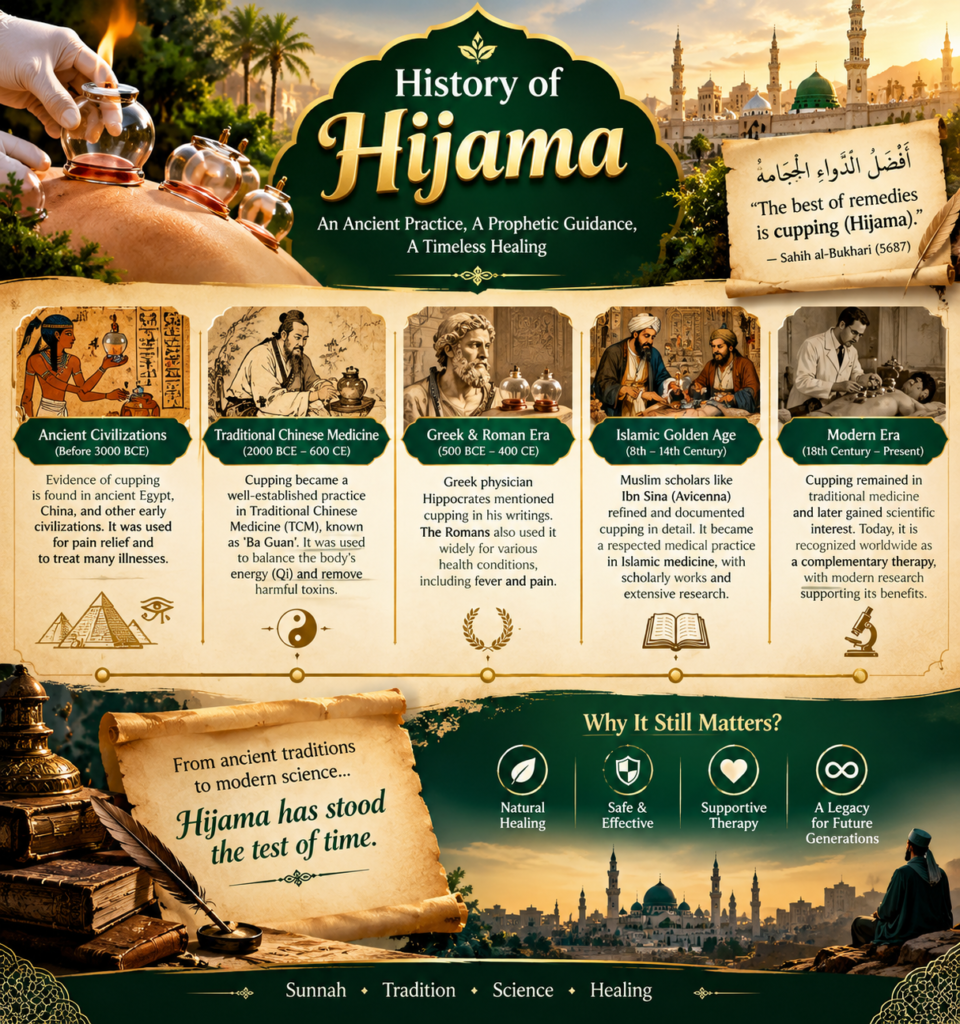
Cupping has a history extending back thousands of years. Forms of suction-based treatment have been associated with several ancient societies, although the precise origins of the practice are difficult to establish.
Historical accounts describe the use of hollowed animal horns, bamboo, and other materials to create suction over the skin. Over time, practitioners developed different techniques and used cups made from materials such as pottery, metal, glass, and bamboo.
These early practices were based on the medical beliefs of their respective societies. They formed part of broader traditional approaches to understanding the human body and treating illness.
It is important to recognise that historical use demonstrates the longevity of a practice, not necessarily its effectiveness according to modern scientific standards.
2. Cupping in Ancient Egypt
Ancient Egypt is frequently discussed in histories of traditional medicine. Egyptian medical traditions included a range of treatments, remedies, and practical approaches to caring for the body.
Cupping is often associated with ancient Egyptian medicine in historical accounts. However, the exact evidence for particular cupping techniques, their dates, and their uses must be assessed carefully rather than assuming that every modern form of Hijama existed in the same way during that period.
The broader history of Egyptian medicine illustrates how early societies developed and transmitted different therapeutic ideas.
3. Cupping in Traditional Chinese Medicine
Cupping also developed within Chinese medical traditions and continues to be associated with traditional Chinese medicine today.
Historically, practitioners used materials such as bamboo and other cups to create suction on the skin. Different methods evolved, including techniques involving heat or mechanical suction.
Traditional Chinese medicine developed its own explanations for the purpose of cupping, which differ from the concepts found in Islamic and other medical traditions.
Modern cupping practices vary by region and practitioner. Some use dry cupping, while others incorporate additional techniques. Their possible health effects need to be evaluated individually through scientific research.
4. Cupping in Ancient Greece and the Mediterranean World
Cupping was also known in the wider Mediterranean medical world. Ancient Greek physicians, including practitioners associated with the Hippocratic medical tradition, used a variety of therapeutic methods.
History of Hijama – The Indian Institute Of Hijama Cupping Therapy & Healing House
Cupping became part of the broader collection of treatments employed by historical physicians. It was interpreted through the medical theories of the time, which differed substantially from modern anatomy and physiology.
As medical knowledge travelled between societies, treatments and ideas were exchanged, adapted, and incorporated into different traditions.
These historical developments contributed to the long and diverse story of cupping therapy.
5. The Development of Cupping in the Arab and Islamic World
The history of Hijama holds particular importance in the Arab and Islamic world. Cupping was known in the region as part of wider traditional medical practices, and Islamic texts later preserved important references to the Prophet Muhammad ﷺ receiving cupping treatment.
Muslim scholars and physicians contributed to the preservation and discussion of medical knowledge through books, teaching, clinical observation, and the exchange of ideas.
Hijama became associated with the tradition commonly called Al-Tibb al-Nabawi, or Prophetic medicine, which includes health-related guidance and practices discussed in Islamic sources and later scholarly works.
Its significance in Muslim communities reflects both its therapeutic history and its religious and cultural associations.
6. Hijama in the Life and Sunnah of Prophet Muhammad ﷺ
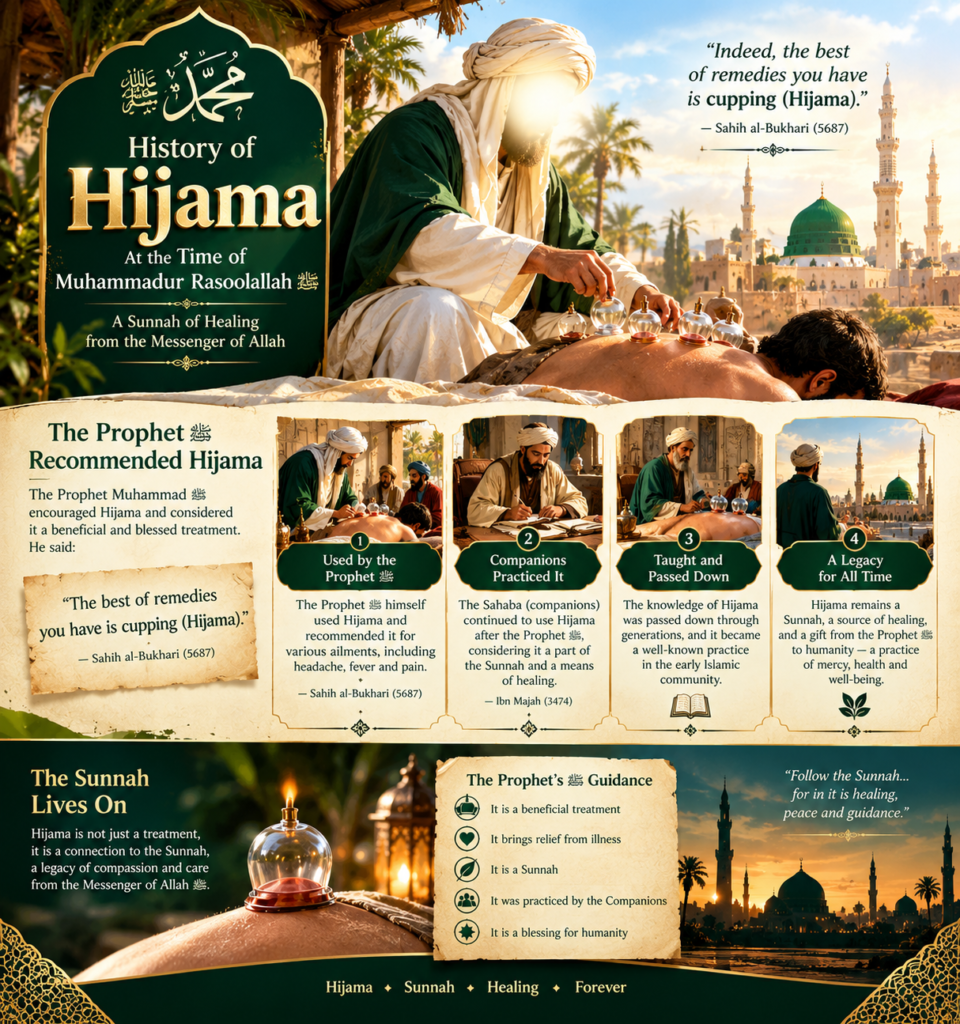
One of the most important reasons Hijama remains widely recognised among Muslims is its association with Prophet Muhammad ﷺ.
Authentic Hadith narrations describe the Prophet ﷺ receiving cupping treatment. Reports concerning this practice are found in major Hadith collections, including Sahih al-Bukhari.
These narrations have influenced the understanding and practice of Hijama among Muslim communities for generations.
For many Muslims, Hijama is not simply a traditional therapy; it is also connected with the study of Prophetic medicine and the desire to understand the Sunnah.
Religious texts should nevertheless be interpreted carefully. The significance of a practice in Islamic tradition does not automatically establish every modern medical claim made about it.
7. Hijama in Islamic Scholarship
Throughout Islamic history, scholars discussed health, medicine, and the treatment practices known in their societies. Hijama appeared in discussions of Prophetic medicine and traditional healthcare.
Historical medical writings often combined religious teachings with the medical theories and observations available during their authors’ lifetimes.
When studying these works today, it is helpful to distinguish among:
- References found in the Quran.
- Hadith narrations concerning cupping.
- Interpretations offered by Islamic scholars.
- Medical theories held by historical practitioners.
- Findings from contemporary scientific research.
This distinction allows readers to appreciate the historical and religious significance of Hijama without confusing traditional explanations with established modern medical knowledge.
8. The Spread of Hijama Across Different Regions
As people travelled, traded, migrated, and exchanged knowledge, cupping practices spread and changed across many regions.
Different communities developed their own techniques, terminology, equipment, and explanations for cupping. Within Muslim societies, Hijama continued to be practised as part of traditional medicine and remained associated with Prophetic medicine.
Today, cupping is known in many parts of the world, including the Middle East, South Asia, East Asia, Europe, and other regions.
In South Asia, Hijama has attracted interest among people exploring traditional wellness practices and Islamic medical heritage. Training programmes and wellness services now introduce different forms of cupping, although the quality of training and safety standards can vary considerably.
9. From Traditional Methods to Modern Equipment
The tools used for cupping have changed considerably over time.
Early practitioners used naturally available materials, while later methods incorporated manufactured cups and different approaches to producing suction.
Modern equipment may include glass, plastic, silicone, or other materials, with manual or mechanical suction systems.
Dry cupping uses suction on intact skin. Wet cupping involves superficial skin punctures or incisions and the collection of a small amount of blood.
These procedures have different safety requirements. Wet cupping requires sterile, single-use instruments, appropriate blood-exposure precautions, and safe disposal of contaminated materials.
History of Hijama – The Indian Institute Of Hijama Cupping Therapy & Healing House
Advances in equipment do not remove the need for proper training, individual assessment, and careful infection prevention.
10. Hijama in the Modern World
Today, cupping continues to be used in some traditional and complementary healthcare settings. It has also attracted interest from researchers investigating its possible effects on pain and other symptoms.
Some studies suggest potential short-term benefits for certain musculoskeletal complaints, but the quality of evidence varies, and further well-designed research is needed to clarify effectiveness and safety.
Hijama should not be described as a scientifically proven cure for every disease or as a reliable method of removing all toxins from the body.
Wet cupping also carries risks, including bleeding, infection, scarring, and anemia with repeated blood loss. Anyone considering treatment should discuss its suitability with a qualified healthcare professional, particularly if they have an underlying medical condition or take medication affecting blood clotting.
The continued study of cupping provides an opportunity to examine traditional practices with both historical appreciation and scientific care.
11. The Difference Between Traditional Beliefs and Scientific Evidence
A long history can explain why a treatment remains culturally important, but it cannot by itself establish that the treatment is effective for a particular condition.
Traditional accounts may describe how earlier practitioners understood the body and illness. Modern research investigates treatment outcomes using methods designed to assess possible benefits, risks, and limitations.
For Hijama, these perspectives can be considered separately and respectfully.
Historical evidence helps us understand where cupping was used and how it developed. Religious sources explain its significance within Islamic tradition. Scientific studies help evaluate its possible effects on health.
A balanced understanding acknowledges the value of historical knowledge while avoiding unsupported medical promises.
12. Preserving the Heritage of Hijama Through Education
At The Indian Institute of Hijama Cupping Therapy & Healing House, we recognise the importance of preserving knowledge about Hijama’s historical and cultural development.
Our educational approach encourages learners to explore its traditional background, Islamic significance, practical methods, and modern safety requirements.
We believe that responsible learning should include an understanding of hygiene, infection prevention, contraindications, ethical conduct, and the limitations of available scientific evidence.
By combining historical awareness with safety-conscious education, we aim to encourage informed engagement with Hijama and its place in traditional wellness practices.
13. Why Learn About the History of Hijama?
Understanding the history of Hijama helps learners and readers:
- Appreciate the practice’s place in different civilisations.
- Understand its significance in Islamic tradition.
- Explore how traditional medical knowledge developed.
- Recognise the differences between historical beliefs and modern research.
- Understand why safe and responsible practice matters today.
- Make more informed decisions about complementary therapies.
Studying history is not simply about looking at the past. It also helps us understand how traditional practices are interpreted, adapted, and evaluated in the present.
Frequently Asked Questions About the History of Hijama
How old is Hijama?
Cupping has a history extending back thousands of years, although the exact origin of the practice and the earliest use of the term Hijama are difficult to establish precisely.
Where did Hijama originate?
There is no single, definitively established birthplace for all forms of cupping. Related techniques developed in different societies, including parts of Africa, Asia, and the Mediterranean world.
Is Hijama part of Islamic tradition?
Yes. Hijama is strongly associated with Islamic tradition because authentic Hadith narrations describe Prophet Muhammad ﷺ receiving cupping treatment.
Is Hijama mentioned in the Quran?
The Quran does not explicitly mention Hijama by name. Direct references to cupping are found in Hadith literature.
How was Hijama performed in the past?
Historical methods varied. Practitioners used different materials and suction techniques according to the tools and medical traditions of their societies.
Is traditional Hijama the same as modern cupping?
The underlying use of suction is similar in many techniques, but equipment, procedures, terminology, and safety standards have changed. Dry and wet cupping should also be distinguished because wet cupping involves breaking the skin.
Is Hijama scientifically proven?
Research has examined cupping for several conditions, especially pain. Evidence remains uncertain for many claimed benefits, so it should not be presented as a guaranteed treatment or a substitute for necessary medical care.
Conclusion: Honouring the Past, Learning for the Future
The history of Hijama reflects the movement of traditional medical knowledge across cultures and generations. From early suction-based techniques to its enduring place in Islamic medical heritage, cupping has remained a subject of cultural interest and therapeutic discussion.
Its association with the Sunnah gives Hijama particular significance for many Muslims, while modern research continues to examine its potential benefits and limitations.
History of Hijama – The Indian Institute Of Hijama Cupping Therapy & Healing House
By learning about its history, respecting authentic Islamic sources, and prioritising safety and reliable evidence, we can better understand Hijama as both a traditional practice and a subject of ongoing study.
Preserving Tradition. Advancing Knowledge. Practising Responsibly.
The Indian Institute of Hijama Cupping Therapy & Healing House
Honouring the heritage of Hijama through education, historical awareness, and responsible wellness practices.
Educational Disclaimer: This page provides general historical and educational information. It is not medical or religious advice. Historical use does not establish clinical effectiveness. Consult a qualified healthcare professional before undergoing cupping therapy, and seek recognised scholarly guidance for detailed Islamic interpretations.
The History of Hijama: A Journey Through Civilisations, Faith and Traditional Medicine
14. The Evolution of Cupping Through the Centuries
The history of cupping is closely connected with the development of traditional medicine. Across different periods, communities developed methods of treating illness based on the medical knowledge, cultural beliefs, and resources available to them.
Early cupping techniques were relatively simple. Practitioners used hollow objects to create suction against the skin. Over time, cups became more specialised, and different methods of applying and controlling suction emerged.
As medical knowledge travelled between regions, cupping practices were adapted to local traditions. The terminology, materials, and explanations associated with these procedures differed from one society to another.
The evolution of cupping demonstrates how traditional therapies can change over time while retaining some of their original techniques.
15. Cupping in Medieval Medical Traditions
During the medieval period, medical knowledge circulated through Arabic, Persian, Greek, Indian, and other intellectual traditions. Physicians studied earlier writings, recorded observations, and developed treatments according to the medical theories of their time.
Cupping appeared in several historical medical systems. It was sometimes discussed alongside other procedures intended to address symptoms or restore what practitioners believed to be bodily balance.
These historical explanations were shaped by the knowledge available at the time and should not be confused with modern physiological understanding.
The study of medieval medicine helps researchers understand how therapeutic practices were documented, taught, and transmitted across generations.
16. Hijama and the Tradition of Prophetic Medicine
Within Islamic history, Hijama is closely associated with Al-Tibb al-Nabawi, a term commonly used for Prophetic medicine.
This tradition includes health-related teachings and practices discussed in Hadith literature and later Islamic scholarship. Cupping is among the practices mentioned in reports about the Prophet Muhammad ﷺ.
For Muslim communities, these references have helped preserve Hijama as a recognised part of religious and cultural heritage.
Studying Prophetic medicine involves examining the original sources, their authenticity, their historical context, and the interpretations offered by qualified scholars. This approach helps preserve religious accuracy while distinguishing traditional guidance from modern clinical conclusions.
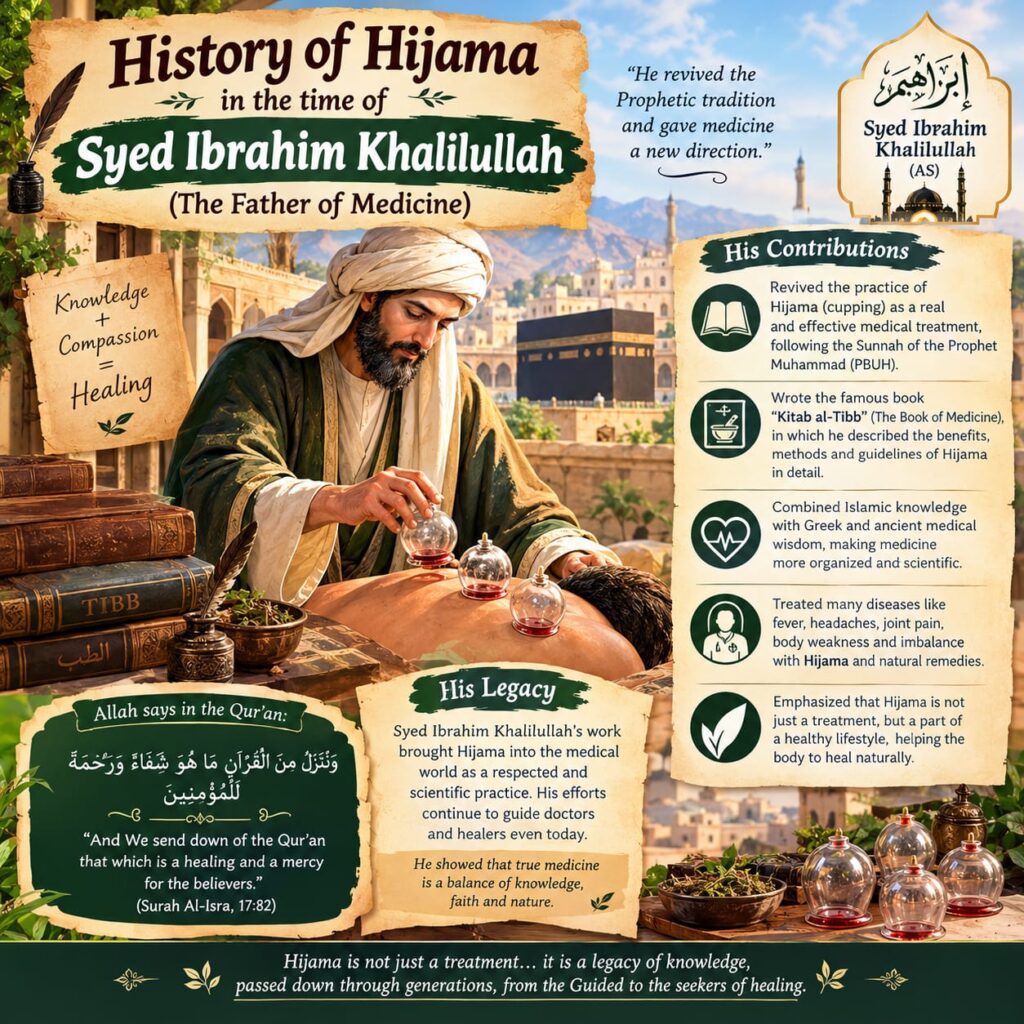
17. The Historical Development of Hijama Equipment
The equipment used for cupping has developed significantly over the centuries.
Early Materials
Historical practitioners used materials that were locally available, including hollow horns, bamboo, and other natural materials. The design and function of these objects varied across societies.
Traditional Cups
Pottery, glass, metal, and other materials were used in different cupping traditions. Practitioners developed methods for creating suction and positioning cups over selected areas of the body.
Modern Equipment
Contemporary practitioners may use glass, plastic, or silicone cups, together with manual pumps or other suction mechanisms.
Modern equipment can make suction easier to control, but safe practice still depends on appropriate training, correct use, and suitable hygiene procedures.
For wet cupping, instruments that penetrate the skin must be sterile and single-use, and contaminated materials must be handled and disposed of safely.
18. The Difference Between Dry Cupping and Wet Cupping in History
Cupping encompasses several techniques, and not all historical or contemporary methods involve drawing blood.
Dry cupping involves applying suction to intact skin. Depending on the technique, cups may remain stationary or be moved over the skin.
Wet cupping, commonly associated with Hijama in many Islamic traditional settings, involves superficial skin punctures or incisions after suction, allowing blood to enter the cup.
These techniques should not be treated as identical. Wet cupping introduces additional risks because it involves blood exposure and skin injury.
Understanding the distinction is important for historical study, modern education, and safe decision-making.
19. Hijama in the Indian Subcontinent
The Indian subcontinent has a long and diverse history of traditional healthcare, shaped by local practices and exchanges of knowledge with other regions.
Cupping has been known in different traditional medical communities, including those influenced by Unani medicine and broader Islamic medical traditions.
Within South Asian Muslim communities, Hijama has also been valued for its association with Prophetic medicine.
In contemporary India, interest in Hijama can be found among people exploring traditional wellness practices, Islamic heritage, and complementary therapies.
However, practitioners and training organisations must distinguish cultural or religious interest from legal authorisation to provide treatment. Requirements may vary according to the location and the nature of the procedure.
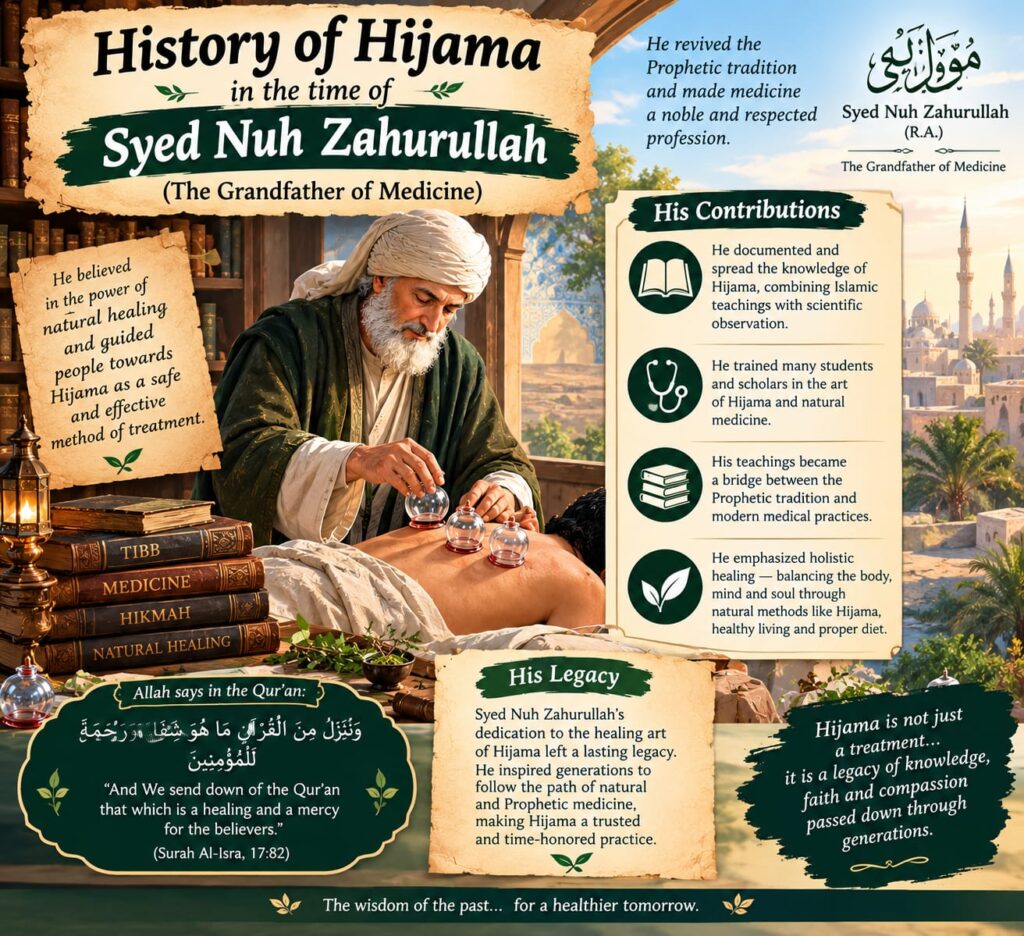
20. Hijama in the Contemporary Muslim Community
Today, Hijama remains an important subject of interest for many Muslims around the world.
Some individuals explore it because of its association with the Sunnah, while others are interested in its historical background or possible role as a complementary therapy.
Educational programmes, wellness centres, and practitioners introduce different approaches to cupping. The quality of training, qualifications, and safety practices may vary, making it important for people to check a provider’s experience and procedures before receiving treatment.
Responsible practice should include clear explanations, informed consent, appropriate hygiene, and honest communication about the limits of scientific evidence.
21. How Modern Science Studies Cupping
The historical importance of Hijama is different from the scientific question of whether it benefits a particular health condition.
Modern research has investigated cupping for conditions including back pain, neck pain, and other musculoskeletal complaints. Some studies report possible improvements in symptoms, but research quality and findings vary.
Further well-designed studies are needed to establish which conditions, if any, may benefit reliably and to clarify the balance between potential benefits and risks.
Research should also distinguish dry cupping from wet cupping because their procedures and risks differ.
History of Hijama – The Indian Institute Of Hijama Cupping Therapy & Healing House
Wet cupping may cause bleeding, infection, scarring, or other complications. Repeated blood loss can contribute to anemia. People should seek appropriate medical advice before treatment, especially when they have underlying health conditions or take medicines affecting blood clotting.
22. Preserving Historical Knowledge Through Education
Historical knowledge is valuable when it is documented carefully and shared accurately.
Preserving the heritage of Hijama involves studying reliable historical accounts, examining Islamic sources responsibly, and recognising the diversity of traditional medical practices.
Education should also explain that historical popularity does not establish medical effectiveness. Claims about treatment outcomes need to be assessed through appropriate scientific research.
A balanced educational approach allows future generations to understand Hijama’s historical significance while making informed decisions about its use today.
23. Our Role in Preserving the Heritage of Hijama
At The Indian Institute of Hijama Cupping Therapy & Healing House, we value the preservation of knowledge about Hijama’s history, Islamic significance, and traditional practice.
Our educational approach aims to encourage learners to explore the historical background of cupping, understand relevant religious sources, and develop an awareness of modern safety standards.
We believe that preserving a traditional practice also requires responsible communication, respect for individual health needs, and a willingness to distinguish established facts from assumptions.
Through historical awareness and safety-conscious education, we hope to contribute to a more informed understanding of Hijama.
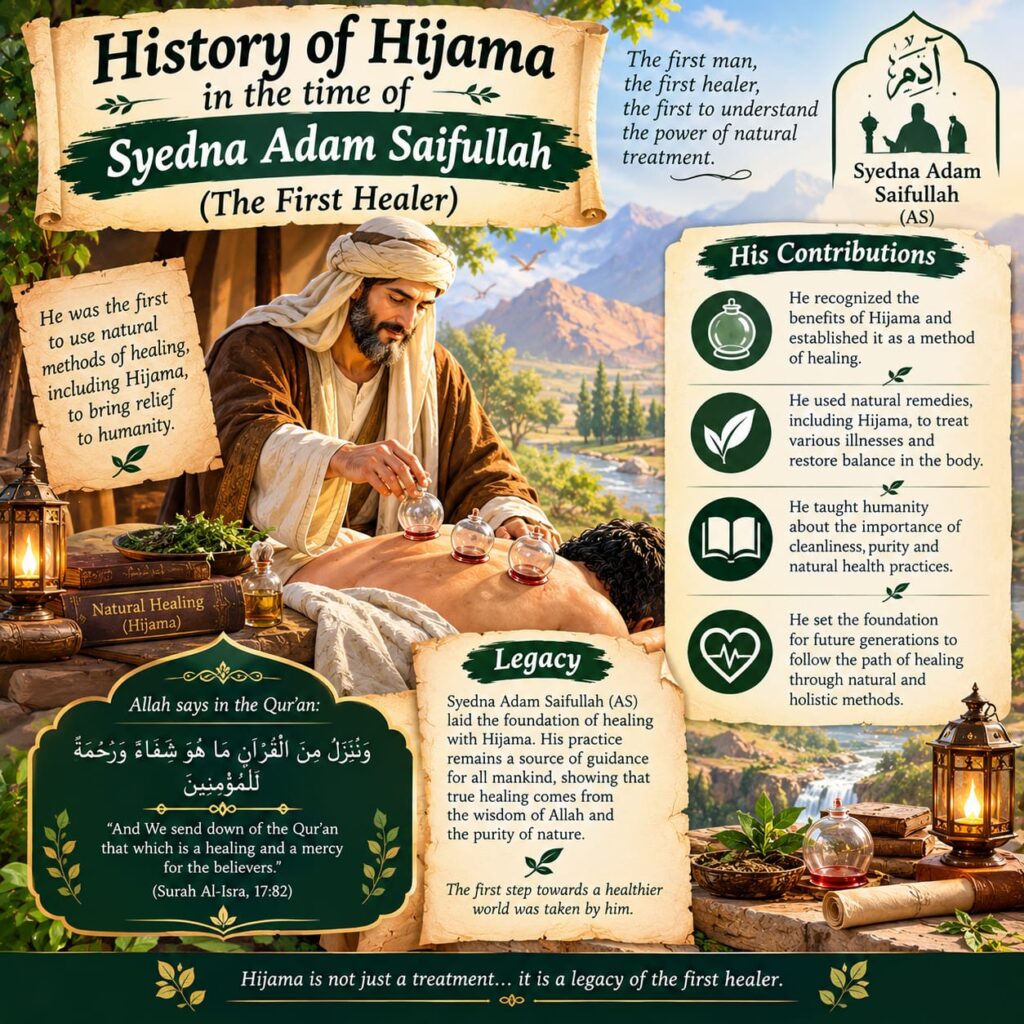
24. Important Historical Lessons
The history of Hijama offers several lessons for contemporary readers and practitioners:
- Traditions develop over time: Cupping practices have changed across societies and historical periods.
- Sources matter: Historical and religious claims should be supported by reliable references.
- Cultural significance deserves respect: Hijama has meaningful historical and religious associations for many communities.
- History is not clinical proof: A treatment’s long use does not establish its effectiveness for a particular condition.
- Safety remains essential: Modern practice should follow appropriate hygiene, training, and risk-management standards.
- Knowledge continues to develop: Historical research and modern scientific studies can contribute different forms of understanding.
Frequently Asked Questions: More About Hijama History
Was Hijama practised before Islam?
Cupping practices existed in several societies before the emergence of Islam. The specific origins of individual techniques and their relationship to later forms of Hijama are not always possible to establish precisely.
How did Hijama spread across different countries?
Cupping techniques travelled through cultural contact, trade, migration, medical teaching, and the exchange of written knowledge. Different regions adapted them according to their own traditions.
What role did Muslim physicians play in the history of cupping?
Muslim physicians and scholars contributed to the wider history of medicine by studying, recording, and transmitting medical knowledge. Hijama was discussed within the broader tradition of Prophetic medicine and historical healthcare.
Has Hijama changed over time?
Yes. The materials, equipment, techniques, and professional safety practices associated with cupping have changed considerably across historical periods.
Why is Hijama still practised today?
Reasons include its historical significance, its association with Islamic tradition, cultural continuity, and interest in complementary therapies. Its use today should be informed by an understanding of both potential risks and the limits of current evidence.
Is the history of Hijama the same as the history of all cupping therapy?
Not exactly. Cupping is a broad category of practices found in different cultures. Hijama commonly refers to cupping in Islamic and Arabic contexts, particularly wet cupping, although terminology and usage can vary.
Final Reflection: From Ancient Practice to Modern Understanding
The history of Hijama is a story of traditional knowledge, cultural exchange, religious heritage, and changing approaches to health.
Its place in Islamic tradition has helped preserve its significance among Muslim communities, while its wider history demonstrates that cupping was used in different forms across many societies.
By exploring its past with historical care, studying religious sources responsibly, and considering modern scientific evidence, we can develop a more complete understanding of Hijama.
The Indian Institute of Hijama Cupping Therapy & Healing House
Preserving Heritage. Sharing Knowledge. Encouraging Responsible Practice.
Historical and Medical Disclaimer: This content is intended for general education. Historical accounts may differ in their interpretation and level of evidence. Hijama is a complementary practice, and evidence for many claimed health benefits remains limited. It should not replace medical diagnosis or necessary treatment.
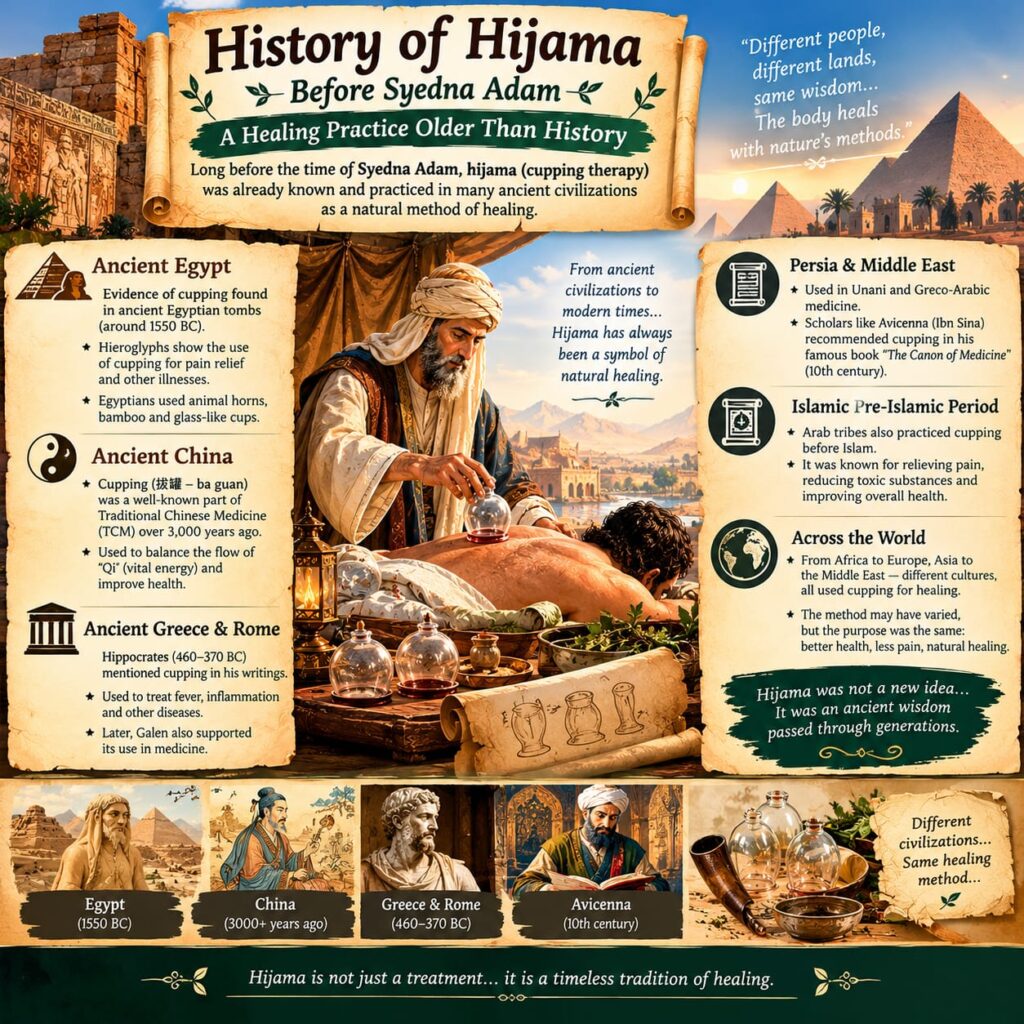
The History of Hijama: From Ancient Traditions to Modern Practice
1. Hijama in the Ancient World
Cupping is one of several traditional therapeutic practices that developed in different parts of the world. Historical accounts describe the use of cups, horns and other hollow instruments to create suction on the skin.
Early practitioners used locally available materials, including animal horns, bamboo and pottery. Techniques differed across regions, and historical descriptions do not always establish exactly how each method was performed.
History of Hijama – The Indian Institute Of Hijama Cupping Therapy & Healing House
Over time, cupping became part of several traditional healing systems. Its history reflects the ways different cultures understood the body, illness and healthcare.
2. Hijama in Islamic Heritage
Hijama holds a distinctive place in Islamic medical tradition. The Arabic term Hijama is associated with cupping, particularly wet cupping, in which suction is combined with controlled superficial skin incisions.
Islamic literature preserves narrations describing the Prophet Muhammad ﷺ receiving cupping. These reports helped maintain interest in the practice among Muslim communities across many generations.
For Muslims, Hijama may have religious and cultural significance as well as a place in traditional wellness practices. However, religious significance and modern clinical evidence are different matters; each should be understood in its own context.
3. The Role of Traditional Practitioners
Historically, cupping was performed by practitioners whose knowledge was passed down through observation, experience and apprenticeship. Their methods varied according to local customs, available equipment and prevailing medical beliefs.
Traditional knowledge contributed to the continuation of cupping, but historical experience alone cannot establish that a treatment is effective for every condition.
Today, practitioners should combine an understanding of traditional context with modern hygiene, informed consent, appropriate training and awareness of medical risks.
4. The Development of Cupping Equipment
Cupping equipment has changed considerably over time.
- Traditional horns: Hollow horns were used in some cultures to create suction.
- Ceramic and glass cups: These became associated with various historical cupping traditions.
- Bamboo cups: Bamboo was used in some East Asian practices.
- Modern plastic cups: Contemporary equipment may include valves or suction pumps.
- Single-use medical supplies: Sterile, disposable items are particularly important when skin is broken.
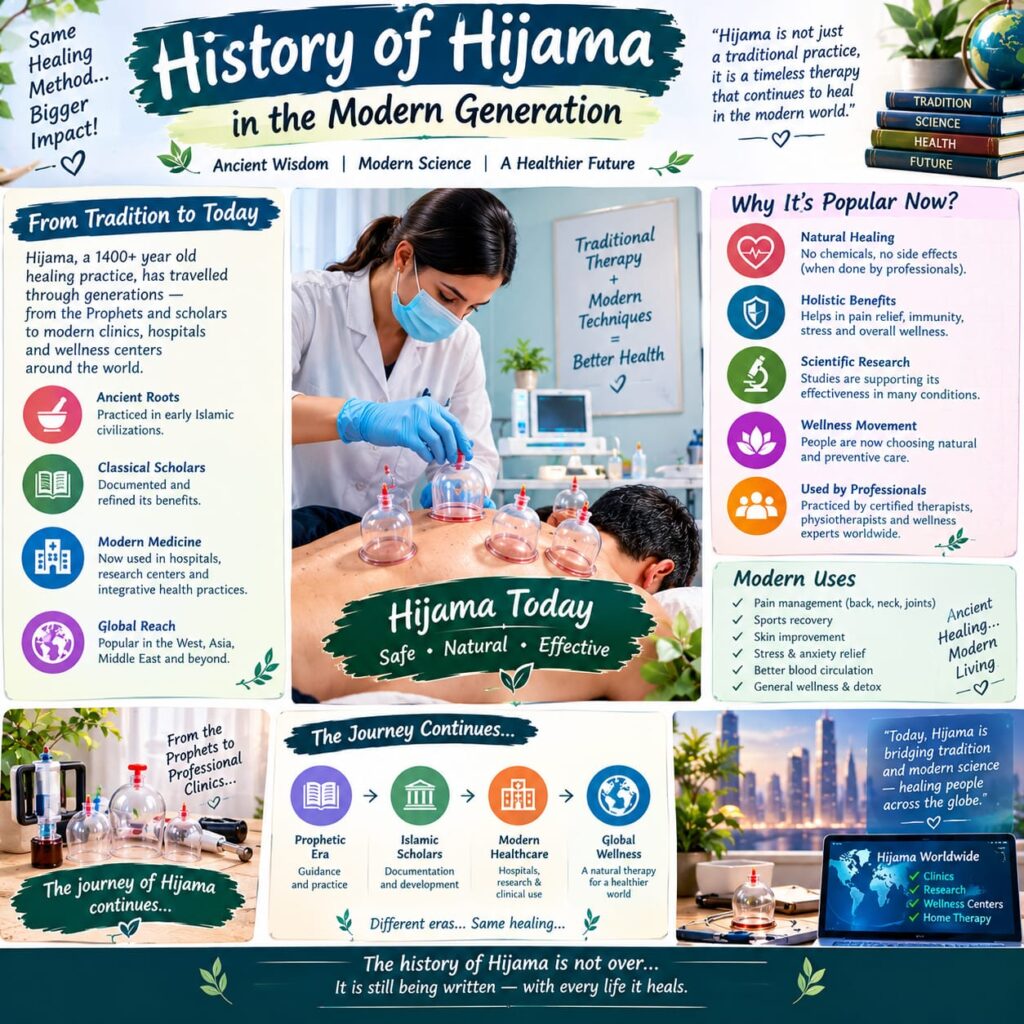
Modern equipment can make suction easier to control, but equipment alone does not guarantee safe practice. Appropriate technique, infection prevention and correct disposal of contaminated materials remain essential.
5. Hijama in South Asia
Cupping practices have been known in South Asia through a combination of local healing traditions, Unani medicine and Islamic medical heritage. Their use and terminology have varied among communities and practitioners.
In India, traditional cupping is sometimes offered alongside other complementary wellness services. Training standards, practitioner qualifications and local regulatory requirements can differ, so clients should check credentials carefully.
A responsible Hijama centre should clearly explain its procedures, hygiene practices, fees, practitioner training and the limitations of the service.
6. Traditional Practice and Modern Research
Modern research has examined cupping for a variety of symptoms, including some types of musculoskeletal pain. However, the quality and size of studies vary, and evidence remains limited for many claimed benefits.
Cupping should not be presented as a proven cure for chronic disease, infertility, infections, cancer or other serious medical conditions. It should not replace diagnosis, prescribed medication or appropriate medical treatment.
Further well-designed clinical studies are needed to establish which conditions, if any, may benefit, how large those benefits might be and what risks are involved.
7. The Importance of Hygiene and Safety
The history of Hijama also highlights why modern safety standards matter.
Wet cupping breaks the skin and can cause bleeding, infection, scarring and other complications. Repeated procedures may contribute to blood loss and anaemia.
Responsible practice includes:
- Obtaining informed consent before treatment.
- Using appropriate hand hygiene and protective equipment.
- Using sterile, single-use blades and other relevant disposable supplies.
- Never reusing blood-contaminated equipment between clients.
- Disposing of sharps and contaminated materials safely.
- Screening for relevant medical conditions and referring clients to qualified healthcare professionals when necessary.
- Explaining potential risks and realistic expectations without promising a cure.
People with bleeding disorders, anaemia, certain medical conditions or medicines that affect blood clotting should seek advice from a qualified healthcare professional before wet cupping.
8. Preserving Heritage Responsibly
Preserving the history of Hijama means respecting traditional knowledge while being honest about what historical records and modern research can establish.
Educational institutions can help by documenting historical sources, teaching safe procedures, distinguishing religious narrations from clinical evidence and encouraging ethical professional conduct.
The goal should not be to make exaggerated medical claims, but to understand the practice’s cultural history and approach it responsibly in the present day.
Conclusion
Hijama has a long and varied history across different cultures and medical traditions. Its place in Islamic heritage has helped sustain interest in the practice, while changing equipment and contemporary safety standards have influenced how cupping is performed today.
Understanding this history allows readers to appreciate the tradition without confusing historical popularity with proof of medical effectiveness. In modern practice, cultural respect, evidence-informed communication, hygiene and patient safety should remain central.
Important Medical Disclaimer: Hijama and cupping are complementary practices, not substitutes for professional medical diagnosis or treatment. Wet cupping carries specific risks because it involves breaking the skin and drawing blood. Consult a qualified healthcare professional about individual medical concerns.
History of Hijama – The Indian Institute Of Hijama Cupping Therapy & Healing House
Franchise and Business Opportunities
We also welcome enquiries from individuals interested in establishing a Hijama training centre or Healer House under our proposed franchise model.
Depending on the agreed package, franchise support may include training, centre setup guidance, curriculum support, branding resources, business development guidance, and mentorship.
Our published franchise information lists a franchise fee of ₹50,000 and an institute commission of 30% of agreed eligible income or revenue. Prospective partners should request written confirmation of the full investment, commission calculation, contractual obligations, support services, and operating requirements before making a payment.
Business earnings are not guaranteed and depend on location, demand, operating costs, management, and other factors.
Our Philosophy
We believe in a simple principle:
Learn with dedication. Practise with responsibility. Teach with integrity. Serve with compassion.
Our goal is to help people develop their knowledge and skills while encouraging realistic expectations, ethical conduct, and a responsible approach to traditional wellness practices.
Visit Our Institute
The Indian Institute of Hijama Cupping Therapy & Healing House
Address: 61/3 BT Road, Basghola, Paikpara, Kolkata – 700002, West Bengal, India
Phone: +91 90075 88855
Email: iamhijamatherapy@gmail.com
For enquiries about training programmes, treatment appointments, course fees, or franchise opportunities, please contact our team.
Discover the Art of Healing. Learn the Practice of Cupping. Build Your Future Responsibly – History of Hijama